September 29th to October 10th, 2025
A beautiful morning greets us as we prepare to leave Merida, which, though challenging weather wise was a nice experience…a final look at the viaduct and we are off…

The drive from Merida to Vejer de la Frontera (about 350 km / 3.5–4 hours) takes us from Extremadura’s rolling plains into the sun-drenched hills of Cádiz province. The first stretch south of Mérida passes olive groves, cork forests, and whitewashed villages. Crossing into Andalusia, the landscape becomes more rugged, dotted with grazing ibérico pigs and distant mountain ridges. Approaching Vejer, the scenery shifts again, with gentle hills, windmills (of which we saw hundreds), and glimpses of the Atlantic coast before climbing to the town’s hilltop perch overlooking the sea and surrounding countryside.

…the Osborne Bull

Little Clio

windmills & more windmills

Vejer de la Frontera
We had been seeing bull billboards (see above pic) along many highways, but with no discernible advertising…after some sleuthing, we learned the bull silhouette was created in 1956 as a billboard for Osborne’s Veterano brandy, with the first wooden signs being installed in 1957. As the signs became a ubiquitous feature of the Spanish landscape, they transcended their commercial purpose and became a symbol of Spain itself. Finally, in 1997, a law was passed that required the removal of all advertising from highways. However, public and political outcry led to the bulls being protected as a “cultural and artistic heritage” by the Spanish government >>> so the bull lost its name but not its identity and its fame!
Vejer’s history goes back to the Bronze Age, with settlements on the hilltop. It was a Carthaginian and Roman settlement, known as Besaro and Bessipo, respectively. The Moorish era left a lasting impact, evidenced in the town’s layout and architecture. Its name, “de la Frontera,” originates from its location on the border between Moorish and Christian territories during the Reconquista.
For those of you who have read our blog, we have visited many towns and historic sites over the last month….while super interesting, it can also be a tiring experience. Over the next twelve days, we intend to scale back a bit using Vejer de la Frontera (Vejer) as a base, thus reducing the changeovers that require a lot of effort and time expenditure.
Parking in Spain is a never-ending adventure, and our AIRBNB hosts have devised a strategy where they “reserve” a spot with their vehicle and when the guest arrives, they move their car, with the result being the guest can park close to the apartment. As in many things in life, “the devil is in the details”, and while we texted back and forth, it did not go super smoothly. In any event, we finally met up, they helped us with all our “stuff”, and explained the workings of the apartment. WHEW, being a hilltop town, access is either up or down, and most of the town is a “casco antigua”, so cars are largely limited. The unit is very nice, well-equipped, and the rooftop patio is super cool, although access would definitely not be to “code” in Canada…time to chill:

Vejer AIRBNB

Vejer AIRBNB
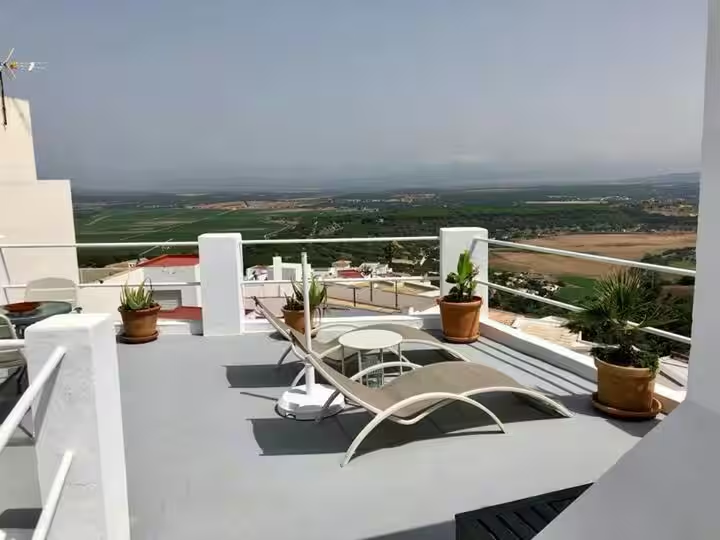
Vejer AIRBNB

Vejer AIRBNB
Our hosts checked in on us from time to time to make sure we were ok and offered restaurant etc,. suggestions. One of these was a local horse riding competition called the Sunshine Tour which they said was closeby, free and maybe enjoyable. We figured why not, this was exactly the type of activity we wanted to experience. Expectations were low, after all a junior riding event was likely to be a very low key event. When we arrived, the parking lots were full, dozens of horse trailers and a monster facilty…no tickets, no one stopping you from check things out …only later did we find it is Europes most modern and complete riding facility: 1300 stables, 7 grass competition arenas, 13 all weather arenas and the worlds largest ‘removable” arena, oh yeah and 7 restaurants in case you get hungry. It was a beautiful, sunny day, good looking horses, some very skilled kids and anxious parents (albeit very well to do parents) agonizing over their kids performances (not unlike peewee hockey tryouts/games):

Sunshine Tour

Sunshine Tour

Commercial “village”

Commercial “village”

Vejer in the background
A great outing …picture of grounds from our patio:
There are numerous beaches within a 45 minute drive and we checked out several, some were so so and some rather pleasant. One of the more interesting was Bolonia Beach an undeveloped beach on Spain’s Costa de la Luz known for its fine golden sand, clear waters, and the massive, shifting Duna de Bolonia. It is also the site of Baelo Claudia a Roman town founded in the 2nd century BC. It grew into a prosperous center, particularly known for its fishing industry and the production of the famous Roman fish sauce garum (similar to modern asian fish sauces). Its golden age was during the rule of Emperor Claudius. The town experienced a decline due to earthquakes and general recession, and was eventually abandoned in the 7th century AD.

Baelo Claudia

Baelo Claudia

Baelo Claudia

Baelo Claudia Teatro

…curious looking critter

Baelo Claudia

Baelo Claudia from the beach
Afterwards, we enjoyed a pleasant walk along the beach and the Duna de Bolonia (90 meters or over a 100 feet high), followed by a relaxed and longish lunch at the Restaurante Bolonia Miramar adjacent to the Roman ruins and Bolonia Beach…this area of Southern Spain enjoys a strong fishery for red tuna, so what better place to taste this local dish:

Bolonia Beach and dune

Duna de Bolonia

Bolonia Miramar

Bolonia Miramar

Red tuna stew

Bolonia Miramar
Beach days are great, but there are also hilltop towns in the vicinity, and Sidon Medina was recommended as a small town with a rich history..Phoenicians, Visigoths, Muslims, with the Christians finally recapturing it during the Reconquista. Today, landmarks like Roman sewers and bridges, Saint Mary’s Church, and the Castle are still standing. Not a major site but interesting nevertheless. The church is in major need of renovations …seeing it in a “raw” state was informative, and the pride of the locals was evident. The lady issuing the entry ticket came over to us several times, trying to explain some of the features, as did another person with modestly better English, not the usual approach at major sites…

Church of Santa Maria la Mayor

Church of Santa Maria la Mayor

Church of Santa Maria la Mayor

Church of Santa Maria la Mayor

Church of Santa Maria la Mayor

Church of Santa Maria la Mayor

Church of Santa Maria la Mayor

Church of Santa Maria la Mayor
Vejer itself is a very pleasant and well-kept village: garbage is picked up daily, streets are washed, houses whitewashed, flowers and plants wherever space allows…

Vejer de la Frontera

Vejer de la Frontera

Grocery shopping
…the heart of the town, though, is the Plaza de Espana with a lovely fountain as its centrepiece…restaurants, bars and various stores. We were only a 5-minute walk away, so several meals were consumed there, and we sometimes just sat on the benches watching life go by…

Plaza de Espana

Plaza de Espana

Plaza de Espana

Plaza de Espana

Town hall

…one of the restos
…we still have several days left in Vejer, Part 2 coming soon!


